
Fifty-six Grantham organisations hold Skilled Worker sponsor licences, but Whitehall will not reveal how many workers they sponsor, the jobs they fill or the salaries paid
The Skilled Worker visa should bring qualified specialists into Britain. It should never become a route for filling ordinary vacancies in petrol stations, convenience stores, restaurants or care homes while British residents remain out of work.
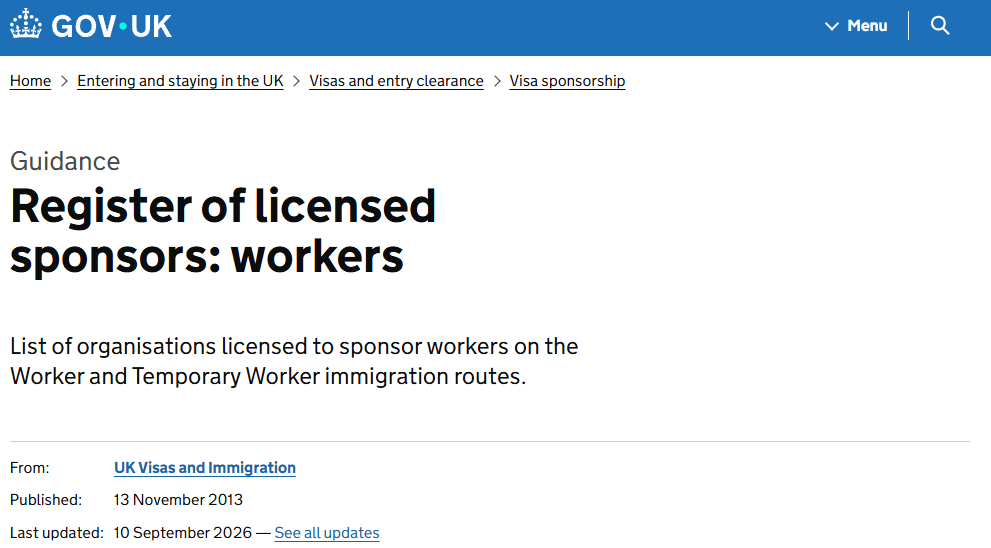
My analysis of the Home Office sponsor register, published on 10 September, identified 798 organisations across the wider Lincolnshire area.
These include:
- 177 organisations in health and social care
- 54 in retail, convenience and consumer services
- 26 in hospitality and food services
- 12 in transport, logistics and vehicle services
The register lists 59 organisations under Grantham. Of these, 56 hold a Skilled Worker sponsor licence. The local entries include five retail or convenience businesses, five hospitality businesses and ten health or social care organisations.
Names on the register include a service station, convenience stores, food and wine shops, newsagents, restaurants and hotels.
That does not prove any of these businesses have recruited a worker from overseas. It does not prove which jobs they may have sponsored. It does not suggest that any named business has broken the law.
That caveat matters. It also exposes the failure at the heart of the system.
The Home Office tells the public which employers hold licences, but refuses to show how many certificates they have issued, which occupations they used, what salaries they offered or where the sponsored workers are employed.
We are being asked to trust a system that hides the evidence needed to judge it.
The latest official figures record 1,810 people in the claimant count across Grantham and Bourne. Across South Kesteven, the figure is 2,420. The claimant count covers people receiving Jobseeker’s Allowance or Universal Credit who fall within the searching-for-work group. It is not identical to the wider unemployment measure, but it gives a firm measure of local residents seeking work. Nomis data for July 2026
Nationally, unemployment stood at 4.9 per cent in April to June 2026. The number of vacancies had fallen to 707,000, its lowest level outside the pandemic period since 2014. Office for National Statistics, August 2026
Against that background, local people deserve to know that employers have made a real effort to recruit and train workers already living here before using an immigration route.
The immigration rules now exclude shop assistants, retail cashiers, shelf fillers and kitchen assistants from the Skilled Worker route. Retail managers, shopkeepers, restaurant managers and chefs remain in restricted categories, largely covering workers who already held continuous Skilled Worker permission before 22 July 2025. They do not appear on the current Temporary Shortage List. Skilled Worker occupation rules
Those restrictions are welcome. They also raise another question. Why do so many businesses operating in sectors dominated by ordinary jobs still appear on the sponsor register?
There may be valid explanations. A convenience store could sponsor an accountant or another qualified professional. A restaurant licence could cover an existing worker admitted under the old rules. A business may hold a licence that it has never used.
The public cannot check any of this.
As county councillor for Grantham West, I do not accept that secrecy is good enough. Local jobseekers should not lose opportunities because an ordinary vacancy has been given an inflated job title. Responsible businesses that invest in wages, training and apprenticeships should not face competition from employers prepared to misuse sponsorship. Overseas workers should not be trapped in jobs where their immigration status leaves them dependent on one employer.
The rules already state that sponsored jobs must be genuine. A job must not be a sham or created mainly to support a visa application. Enforcement must now match those words.
I am calling for the Government to:
- Publish sponsorship figures by local area, business sector, occupation and salary.
- Show how many certificates each sponsor has issued, without publishing workers’ personal information.
- Inspect sponsors in sectors where the advertised job title does not appear to match the work being performed.
- Require proof of local recruitment, pay and training efforts before any lower-skilled exception can be used.
- Suspend licences and impose meaningful penalties when businesses misclassify routine jobs.
- Build a proper Lincolnshire workforce plan covering apprenticeships, rural transport, wages, retention and career progression.
It is not fair to tell someone in Grantham to stay on Universal Credit while an employer imports labour for an ordinary vacancy without showing that local recruitment has failed.
Labour ministers cannot point to tighter rules and declare the matter closed. They must open the books, police the system and prove that these visas are filling real skills gaps.
Specialist visas should be for specialists.
Source data: https://www.gov.uk/government/publications/register-of-licensed-sponsors-workers






Recent Comments